Policy: No Gaps
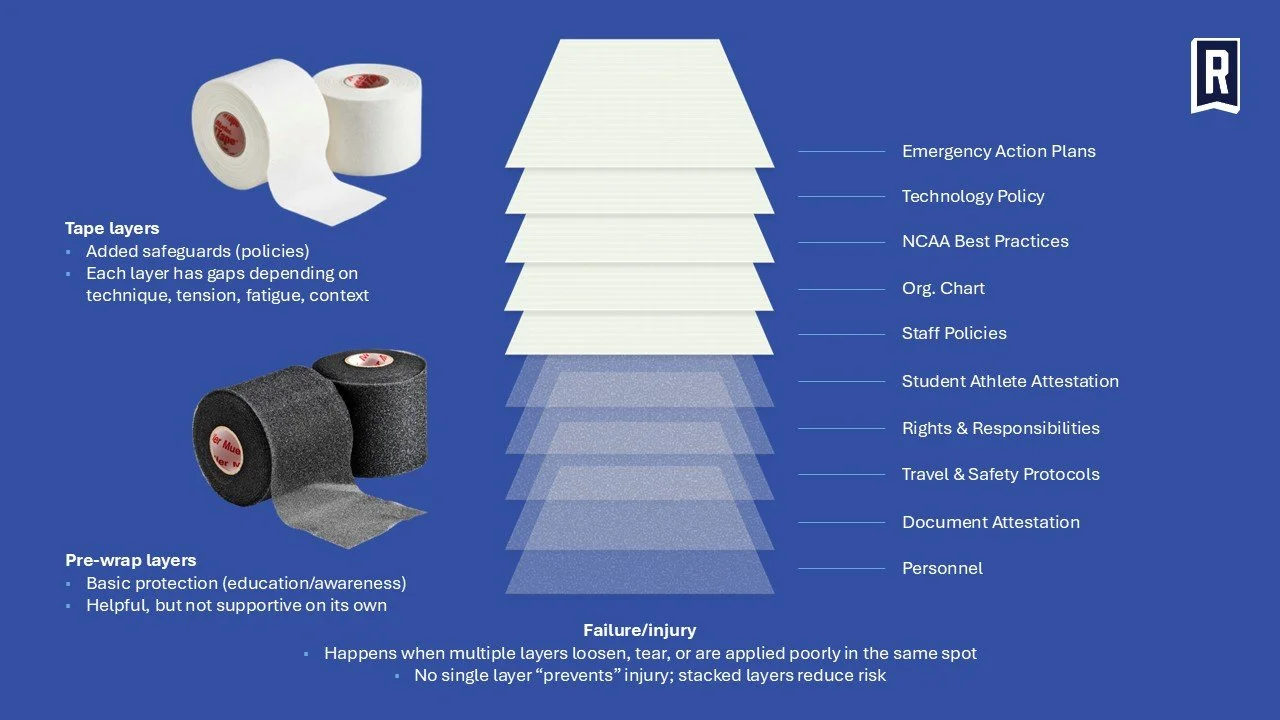
REPS Model created by Grace Johnson for Ralph Reiff
The Swiss Cheese Model: Building Proactive Policy Layers in Athletic Healthcare
In athletic departments across the country, policy development often follows a familiar pattern: something goes wrong, and a new rule emerges in response. Handbooks grow thicker with each incident, creating a reactive patchwork of regulations born from history rather than foresight.
But what if we could build better defenses before problems occur?
The Challenge of Proactive Policy
Being proactive in policy development is notoriously difficult. Most organizations operate under the assumption that "it won't happen here." Additionally, when issues do arise on one campus, there's often little sharing of lessons learned across the broader athletic community. This lack of socialization means institutions repeatedly encounter the same preventable problems.
Understanding the Swiss Cheese Model
The Swiss cheese model—which gained widespread recognition during the COVID-19 pandemic—originated from James Reason's seminal work, Human Error. This model provides a powerful framework for understanding how accidents occur in complex systems.
According to Reason's Theory of Active and Latent Failures, accidents in complex systems like healthcare result from breakdowns or gaps in safety barriers across four critical levels:
Organizational Influences – The top-level policies and culture that shape operations
Supervisory Factors – Management decisions and oversight practices
Preconditions for Unsafe Acts – Environmental and personnel conditions that set the stage
Unsafe Acts – The frontline errors or violations that directly cause harm
Each level represents a “layer of tape” with potential gaps and wrinkles. When the gaps align across all layers, an error passes through unchecked, resulting in an adverse event.
Applying Layers to Athletic Healthcare
Athletic healthcare demands proactive policy that establishes clear boundaries and multiple protective layers to reduce human error. Rather than waiting for incidents to dictate your policy landscape, consider how intentional, layered safeguards can prevent problems before they emerge.
I created the attached image for athletic healthcare settings as a thought-starter for your organization: Where are the gaps in your current policy layers? Which barriers need strengthening? How can you apply a wrinkle-free, no-gap process?
Moving Forward
Effective risk management in collegiate athletics requires moving beyond reactive policymaking. By understanding and implementing layered defenses inspired by the model, athletic departments can build more robust systems that protect student-athletes, staff, and the institution itself.
What does your organization's policy structure look like? Are you building layers proactively, or filling gaps reactively?
Reference: Reason JT (1990). Human error. Cambridge, England: Cambridge University Press.
Let’s build the best model for your institution. Contact Ralph at www.ralphreiff.com